
Beaufort County Multi-Day Arrest Log
The Beaufort County Sheriff's Office posts no full booking blotter online. There is no 72-hour list and no seven-day list. Its official newsroom comes closest. The press-release category there offers selected narratives, not a record of every booking. No posting schedule is stated. Neither a fixed window nor an archive depth appears.
That turns the arrest log into a source-matching exercise. Official news gives the agency's own account of a notable action. The sheriff app shows who is in custody right now. eCourts carries the case that follows the booking. Older records? Ask the sheriff's records custodian for that specific booking report. A release may quote charges or bond. Its date reflects publication, not the date of the arrest itself.
The official newsroom capture shows the selective agency publication channel.
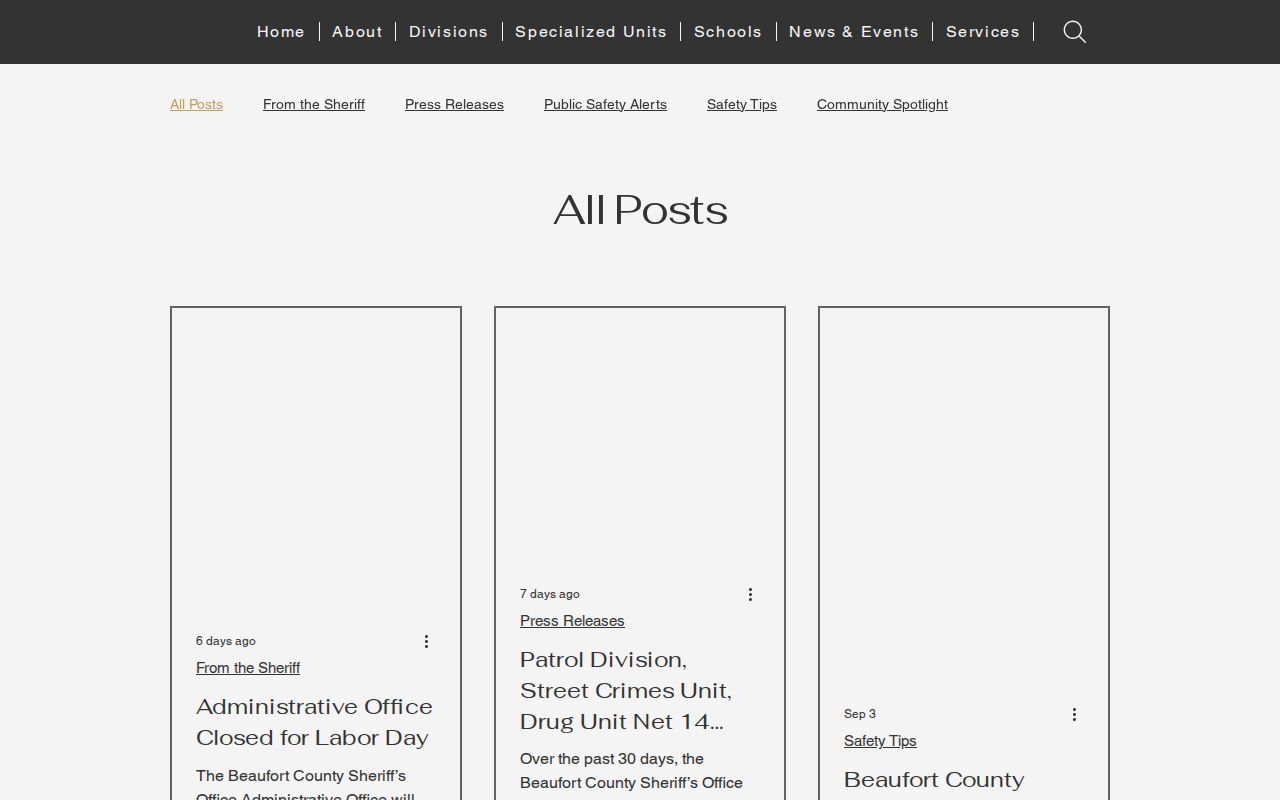
The newsroom shares sourced stories, but it never claims to be a full jail roster.
Read the Beaufort County Blotter
Start with the source that fits your date range. A newspaper column can place an event within a week. The agency and jail keep the real arrest records. A live app result shows present custody only, not the event details or the final court outcome.
- Search the sheriff newsroom and press-release category by date and event terms.
- Check the Washington Daily News weekly sheriff incident column for the relevant span.
- Match the place and incident date rather than relying on the article date.
- Use the sheriff app to check whether the person remains in Beaufort County custody.
- Search eCourts or contact the Clerk for the case and disposition.
- Request the official report when the public window lacks the needed record.
For something that may have happened today, the Beaufort County 24 Hour Arrests route works better. It leans on live status rather than this retrospective publication trail.
Beaufort Arrest-Log Fields Explained
Fields differ by source here. No official complete log exists. Sort each newsroom item, newspaper column, app status, or requested report by the fields below, since none displays every field.
| Field | How to read it |
|---|---|
| Person’s name | Confirm spelling and identity with another identifier. |
| Incident date | The date conduct or a call was reported. |
| Arrest date | May follow the incident date. |
| Booking date | Marks jail intake and may differ from arrest time. |
| Agency | Shows which sheriff or police office handled the event. |
| Location | Describes the incident place, not necessarily the jail. |
| Charge and bond | Accusation and custody terms that can later change. |
| Publication date | Only when a story appeared, not when booking occurred. |
| Photo | May be agency-supplied in a selective story; it is not proof of guilt. |
Incident logs run broader than arrest logs. They can cover traffic calls, alarms, property matters, welfare checks, and other responses with no booking at all. An arrest story may name only a few people. Treat neither as a full count of arrests.
Beaufort Arrest Reports Are Selective
The sheriff's Press Releases page may describe drug enforcement, warrant service, charges, or bond language. Those posts carry weight. The agency speaks for its own action. One post per booking is never promised, though. Ordinary intakes may get no narrative at all.
A release can follow investigation, review, or a communications choice. Its date is not the booking time. A person may be released or transferred before a story runs, so check the live custody route and the court record for any reduced, dismissed, or resolved charge.
The official press-release archive shows the dated narratives themselves.
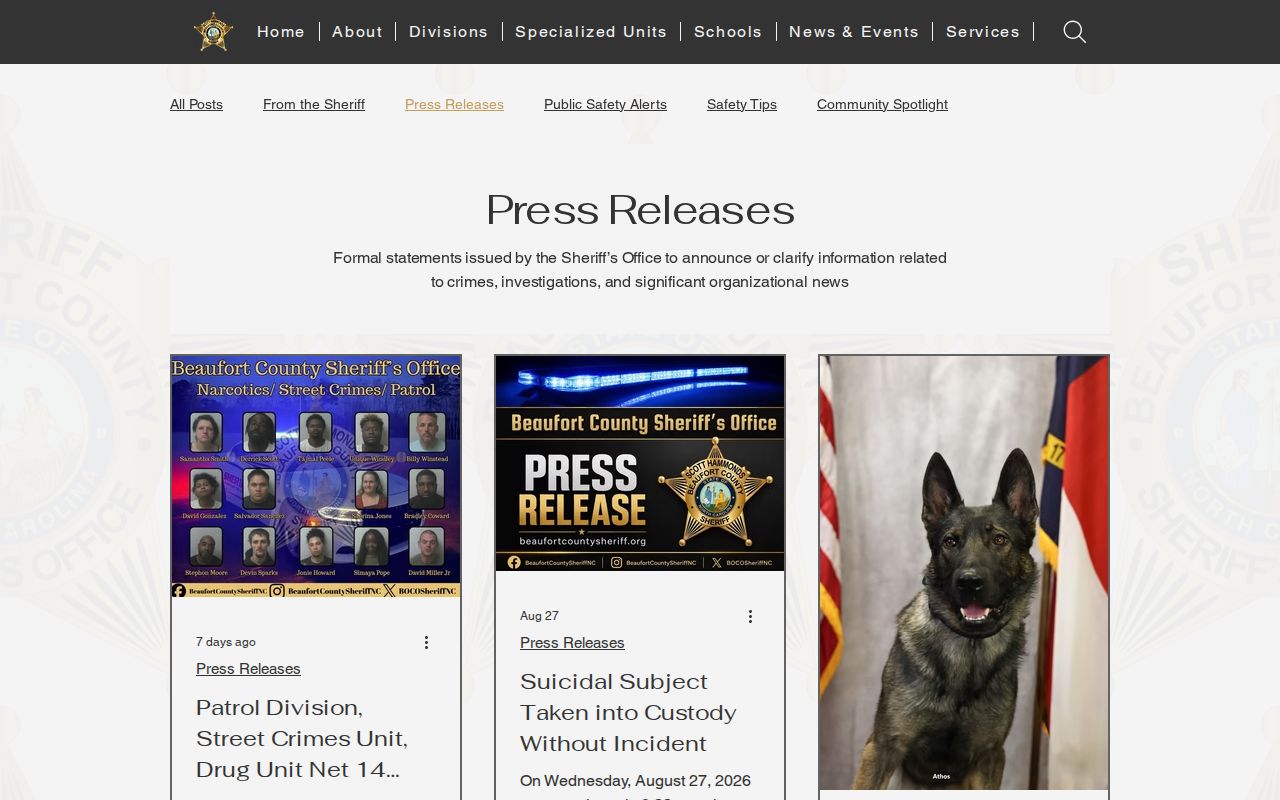
Read each item as a selected agency report. It is not a row in a complete booking feed.
Note: A stated bond is a release condition at that stage, not a sentence or a finding of guilt.
Weekly Beaufort Arrest Context
The Washington Daily News weekly sheriff column is the strongest multi-day blotter source in the county. It groups incidents by date and category. Coverage can reach Washington, Belhaven, Chocowinity, Aurora, Bath, Pinetown, and other communities. It is a paper report, not the jail record. It also includes far more than arrests.
Weekly grouping helps when weekend events surface late. Holidays and court closures can shift when a narrative appears. No source promises a weekend surge or a set Monday posting hour. A later summary cannot fix the arrest time.
Some event-driven stories include agency-supplied images. Those are story assets, not a photo roster. Confirm names, charges, and present custody with the sheriff or the court. Repeating an agency account does not make the paper the official custodian.
Beaufort Enforcement Logs Cover More
The weekly material is an incident log, not a DUI-only or booking-only list. Calls may involve alarms, traffic, or welfare checks. Property matters show up too. Some entries document a response with no arrest. A booking can also be missing simply because it was never selected for publication.
Agency scope matters for trend claims too. Local crime reporting notes that sheriff figures exclude the municipal data of Washington, Belhaven, and Chocowinity. A sheriff total is therefore not a county total. Before comparing figures, identify the reporting agency, the time span, and the event type.
The Eastern NC Now Combat Crime category adds another event-driven secondary view.

That category adds context from time to time. It does not replace an official report or a complete arrest log.
Unofficial Beaufort Booking Archives
Offshoot sites keep Beaufort County arrest pages online long after custody ends. BustedNewspaper and RecentlyBooked both host them. Mugshots.com links a Beaufort County section from its North Carolina index. The copied entries may carry names, charges, or booking photos. None of that is official. Coverage can lag, repeat a record, blend municipalities together, or stay online after a case changes.
RecentlyBooked touts a shifting recent-arrests window. BustedNewspaper stacks page after page of older posts. Neither habit reveals how long the sheriff keeps an official booking card. Beaufort County has no section on Arrests.org, and a Mugshots.zone result for "Beaufort" lands in South Carolina instead. Match both the state and the county with care.
Start with official sources. Use a secondary entry only to approximate a date, then confirm through the sheriff, jail, or court.
Older Beaufort Arrest Records
A page vanishing from public view is not the same as a record being destroyed. North Carolina's sheriff retention schedule sets the clock. Arrest reports left out of a case file are destroyed five years after the arrest. Reports filed in a case follow the felony or misdemeanor case-history rule. DWI tracking records have their own two-year rule. Litigation or audit holds can pause destruction.
Use the sheriff's Incident Report Request for a past record. List the person, the date range, and the location. Add a report number if you have one. Ask which series controls the record. Court files belong with eCourts or the Beaufort County Clerk, not the jail roster. The State Archives helps only when material was transferred or cataloged. Nothing promises recent booking photographs go there.
Name the item you want. An arrest report, a detention incident report, a booking photograph, and a court disposition are distinct items. They can sit in different series. A tight date range helps staff find the file. If the sheriff no longer holds it, ask whether it was lawfully destroyed, placed in a case file, or transferred. An old newspaper page offers a clue, but it cannot answer a records-management question.
Note: Secondary persistence proves neither current custody nor official retention; verify an old entry with the creating agency and the court.